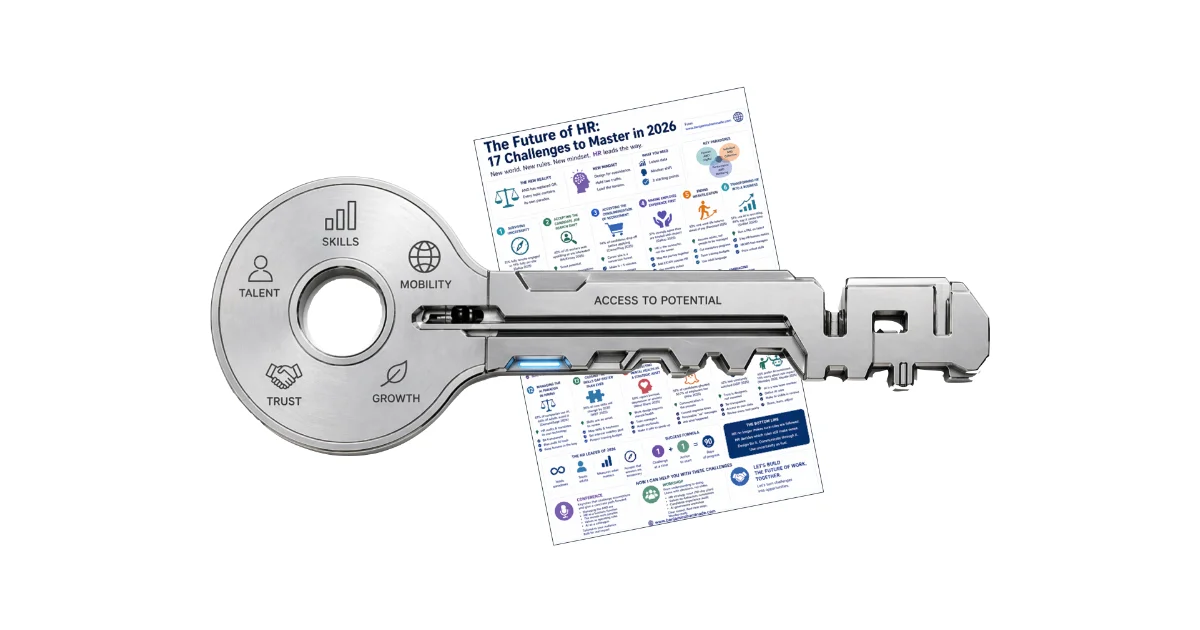
Ten years ago, HR leaders used to plan. Five years ago, they used to react. Today, they do both at the same time, on the same Tuesday, before lunch.
The future of HR: What challenges must HR master to still exist in 2026 and beyond? Spoiler: ‘AND’ has replaced ‘OR’ and most HR teams haven’t noticed yet
The world of work has stopped offering clean choices. Remote or office. Individual or collective. Human or digital. Performance or wellbeing. Every binary that used to structure HR strategy has collapsed into an « AND » that nobody knows how to read yet. The paradoxes are no longer bugs to fix. They are the new operating system.
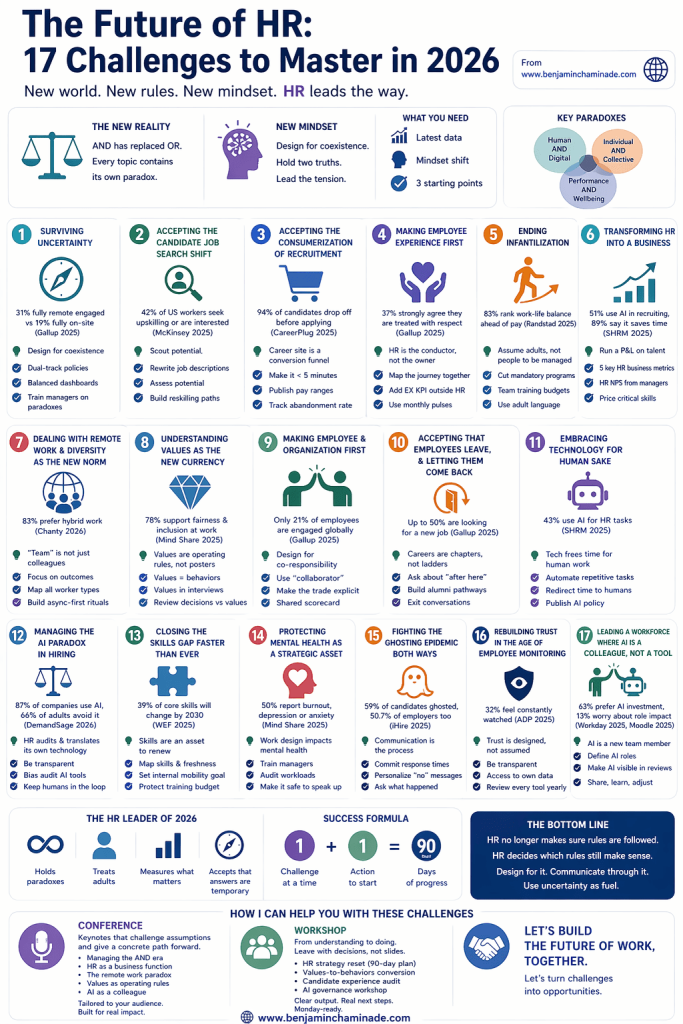
This article is not a trend report. It is a map of the 15 challenges HR leaders are already dealing with, whether they have the language for them or not. Some are old problems that have quietly changed shape. Some are brand new and did not exist in any HR textbook three years ago. All of them share one feature: they cannot be solved with a template.
| The shift | The map | The discipline |
|---|---|---|
| « AND » has replaced « OR » and most HR teams haven’t noticed yet. Remote or office, individual or collective, human or digital. Every binary that used to structure HR strategy has collapsed. | Fifteen challenges HR leaders are already dealing with, whether they have the language for them or not. From the AI paradox in hiring to the remote work paradox, from skills gaps to mental health as a strategic asset. | Pick one challenge, pick one of the three actions under it, run it for 90 days. Then pick the next one. Transformation does not happen in keynote slides but in Monday morning decisions. |
Each challenge comes with the latest data, the mindset shift it requires, and three concrete starting points. No tool will do the work for you, but naming the problem correctly is already half the job.
Surviving uncertainty
Atypical situations have become the expectation. Beyond uncertainties and black swans no one could have predicted months ago, HR is now entering a world where extremes coexist. The choice between individual or collective, digital or human, ecology or economy, freedom or discipline, engagement or remote work is gone. HR has to deal with both ends of the spectrum because « AND » has replaced « OR. »
The proof is now statistical rather than anecdotal. Gallup’s 2025 State of the Global Workplace research shows that fully remote workers report the highest engagement at 31%, against 23% for hybrid workers and just 19% for fully on-site non-remote-capable employees. Yet those same fully remote workers are less likely to be thriving than their hybrid peers, which Gallup now calls « the remote work paradox. » Higher engagement and lower thriving, at the same time, in the same population. This is the shape of the new normal: every HR topic now contains its own contradiction, and the job is to manage both sides at once rather than pick a winner. For a broader view of how uncertainty itself is reshaping management, see my VUCA and BANI series.
What it means as a mindset change: HR leaders stop optimizing for one clean answer and start designing for coexistence. Policies, KPIs, and rituals need to hold two truths at once.
Three things HR can start with:
- Replace every binary policy (« remote or office, » « individual or collective goals ») with a dual-track version that names both options explicitly.
- Audit current HR dashboards and remove any single-number metric (one engagement score, one satisfaction rate) without a counterweight indicator next to it.
- Train managers to recognize and name paradoxes in their teams instead of resolving them too fast.
Accepting the Candidate Job Search Shift
Changing careers, not just employers, is now a top reason people change jobs. The candidate sitting in front of you is less often looking for a better version of what they already do, and more often looking for something they have never done before. This shifts the entire logic of selection, from matching past experience to spotting future potential.
The Bureau of Labor Statistics released updated longitudinal data in August 2025 showing that individuals born between 1957 and 1964 held an average of 12.9 jobs from ages 18 to 58, with over 40% of those jobs held before age 25. The cadence slows with age (4.5 jobs between 25 and 34, 2.9 between 35 and 44, 2.2 between 45 and 54) but the pattern of movement holds across an entire career. On the aspiration side, McKinsey’s 2025 American Opportunity Survey found that 42% of US workers are either actively seeking upskilling opportunities or interested in doing so, and those willing to switch occupations cite missing credentials, experience, or skills as their greatest obstacle. Translated into recruiter reality: more and more candidates arrive with the will and the ability, but without the diploma or the track record. All they have, hopefully, is potential.
What it means as a mindset change: Recruiters shift from gatekeepers of experience to scouts of potential. Résumés describe the past; the job is to assess the future.
Three things HR can start with:
- Rewrite job descriptions to separate « must have on day one » from « can learn in the first 90 days, » and shrink the first list.
- Add at least one structured potential-assessment step (a case, a simulation, a learning task) to every recruitment process.
- Create a clear internal reskilling path so current collaborators can also apply to jobs they have never held before, without penalty.
Accepting the Consumerization of Recruitment
Digitally empowered candidates expect a faster, smoother, and more inclusive recruitment experience that matches their life as consumers. You can order a ride with a tap, track a pizza in real time, and change the temperature of a room from a thousand miles away. The power to choose and order with a fingertip has reshaped how candidates apply for a job. If the process feels slower than their last food delivery, they leave.
The numbers are brutal. According to iCIMS’s 2025 State of Frontline Hiring Report, 60% of workers have started a job application and never finished it, with lengthy forms (50%) and missing salary information (31%) as the top reasons. Appcast’s 2025 Recruitment Marketing Benchmark Report shows that applications under 5 minutes complete at 12.47%, while those over 15 minutes drop to 3.61%. CareerBuilder data goes further: 73% of job applicants abandon applications that take longer than 15 minutes. And CareerPlug’s 2025 Recruiting Metrics Report, based on over 10 million applications across 60,000 businesses, finds that only 6% of people who click on a job ad actually complete an application. In other words, 94 out of 100 interested candidates vanish between the click and the submit. In e-commerce, this is called cart abandonment. In recruitment, it is a slow invisible leak that no sourcing budget can compensate for.
What it means as a mindset change: The career site is not a legal compliance page anymore. It is a conversion funnel, and HR owns the UX.
Three things HR can start with:
- Time your own application process on a phone from a café Wi-Fi, end to end. If it exceeds 5 minutes, cut fields until it does not.
- Publish the salary range on every job ad. SHRM’s 2025 State of Recruiting report shows 70% of organizations posting pay ranges receive more applicants, and 66% say the quality is higher.
- Set up a monthly review of the application funnel with one number in red: the abandonment rate, stage by stage.
Making Employee Experience First
From consumerization, employee experience is now mirroring customer experience. HR is deploying empathy to see the work through the eyes of the collaborator, aware of their first career milestones and life context. Processes are reinvented at the convenience of employees, not the other way around. This is why « Head of Employee Experience » and « Chief People Officer » titles have spread from General Electric to McDonald’s, from Airbus to AXA.
What the field has learned since then is that experience is not a department. Whatever sits behind the perfect experience (excellent management, a beautiful physical environment, adapted technology) the most important point is that the employee is not siloed inside HR. Employee experience is an organization-wide effort, including IT, Finance, Marketing, Sales, and workplace design teams. Gallup’s latest wellbeing research shows that only 37% of US employees strongly agree they are treated with respect at work, back to the record low first recorded in 2022. Respect is the one variable no amount of ping-pong tables can fix, and it cuts across every function.
What it means as a mindset change: HR stops being the « experience owner » and becomes the experience conductor, orchestrating IT, Finance, Marketing, and facilities around the same employee journey.
Three things HR can start with:
- Map the end-to-end employee journey with IT, Finance, and facilities in the room, not just HR, and identify the three biggest friction points.
- Add one employee experience KPI to the performance review of at least one non-HR function (for example, Finance for onboarding speed, IT for tool setup time).
- Replace the annual engagement survey with a lighter monthly pulse focused on one dimension at a time, and publish the results internally.
Ending Infantilization at work
With the freedom offered by digital tools and the freelancing of work, employees feel more and more responsible for their own work experience. They do not rely anymore on a manager or HR to hand them a retention program or a mandatory training catalog. They have mastered setting their schedule, solving their own mistakes, and prioritizing their obligations without any authority figure knowing exactly how they organize their work life.
The data confirms the shift has become structural. Randstad’s Workmonitor 2025 found that 83% of employees rank work-life balance ahead of pay (82%), the first time flexibility has overtaken salary in that ranking. Gallup’s hybrid work indicator shows six in ten remote-capable employees want a hybrid arrangement, and six in ten who currently work fully remote say they are extremely likely to look for a new job if that flexibility is taken away. Autonomy is no longer a perk. It is a hiring condition. Some HR teams are following through, dropping top-down retention programs and treating each collaborator as responsible for their own experience. For a deeper look at the risks and limits of this shift, the article on l’entreprise libérée at benjaminchaminade.com/blog is a useful companion read.
What it means as a mindset change: HR stops designing programs that assume collaborators need to be convinced, motivated, or rescued. The starting assumption becomes that they are adults running their own careers.
What it means as a mindset change: HR stops being the « experience owner » and becomes the experience conductor, orchestrating IT, Finance, Marketing, and facilities around the same employee journey.
Three things HR can start with:
- Cut one mandatory HR program per quarter and replace it with an opt-in version. Measure what happens.
- Give each team a training budget they manage directly, with only a light reporting requirement.
- Review the language of internal HR communications and remove infantilizing formulations (« don’t forget, » « please make sure, » « we remind you »).
Transforming HR Into a Business function
HR has become a company inside a company. Its job is to sell jobs internally, buy skills externally, win « talent market share » over competitors, and generate the metrics that help the business shape its future in real time: quality of hire, customer happiness, employee health index. The visible proof is the growing number of HR directors becoming CEOs, with Mary T. Barra at General Motors the most visible example. A second front is opening with « HR hacking, » which argues that everything related to the human (neuroscience, behavioral economics, gamification) should sit under HR supervision, with the obvious double-edged risk between support and manipulation.
The current data backs the shift. SHRM’s 2025 State of the Workplace report shows that 56% of HR professionals consider their organization’s recruiting efforts effective, against only 41% of employees. That 15-point gap is exactly the kind of business signal HR is now expected to read, publish, and act on. SHRM’s 2025 Talent Trends finds that 51% of organizations now use AI to support recruiting efforts, and 89% of HR professionals in those organizations say AI saves them time or increases efficiency. The time saved is the time HR needs to operate as a business function instead of an administrative one.
What it means as a mindset change: HR stops asking for a seat at the table and starts running a P&L on talent, with customers (managers), suppliers (sourcing channels), and inventory (skills).
Three things HR can start with:
- Build one HR business dashboard with five numbers that any CFO would recognize (quality of hire, time to fill, cost per hire, regrettable attrition, internal mobility rate).
- Treat managers as customers: run a quarterly Net Promoter Score on HR services and publish it.
- Identify the three skills your business will need in 24 months and start pricing them in the external market like any other procurement line.
Dealing With Remote Work and Diversity as the New Norm
Globalization and remote work have turned the workforce into an increasingly diverse, contracted, or project-based pool. Diversity is not only about workers coming from other cultures to your workplace. It is about transient people working from their country of origin, gig workers who pop in and out of jobs on a daily basis, and AI bots running in workflows with their own personality and quirks.
The underlying data is now stable enough to plan on. A 2025 Deloitte survey shows that 65% of Gen Z and Millennials would leave their job if forced back to the office full-time. Chanty’s 2026 remote work analysis reports that 83% of global employees prefer a hybrid setup, and Robert Half’s Q1 2026 job posting analysis finds that across roles, 77% of new postings are fully on-site, 19% hybrid and 4% fully remote, a reversal from the post-pandemic peak. The interesting tension for HR is not whether flexibility wins or loses, but the widening gap between what employers post and what candidates accept. Robert Half also finds that 47% of professionals not actively job searching cite not wanting to lose their flexibility as a key reason to stay.
What it means as a mindset change: Diversity management expands from origin and demographics to work arrangements, time zones, contract types, and now non-human agents. « Team » is no longer a synonym for « colleagues. ».
Three things HR can start with:
- Redesign objectives around outcomes, not hours, for every role where it is technically possible, and state it explicitly in the contract.
- Map all the types of workers currently contributing to your company (employees, freelancers, contractors, gig workers, AI agents) and define the HR support each one receives.
- Build rituals that work asynchronously first (written updates, recorded decisions) so remote and transient contributors are not second-class citizens.
Understanding Values as the New Currency
Values have meaning, and they have to be explicit, real, shared, and used everywhere. They must be transcendent to the activity of the company, present in the unboxing experience as well as during a call with a representative or a question asked to a new candidate. In a labor market where collaborators can leave fast, values are one of the few things that travel with the employer brand rather than with the paycheck.
The 2025 Mind Share Partners and Qualtrics Mental Health at Work Report, based on 1,153 US full-time workers, shows that 78% of workers support the promotion of fairness and inclusion at work, and that respondents at companies still committed to diversity, equity, and inclusion initiatives reported a better relationship to work, less stigma, and higher trust. On the retention side, the same report finds that work-life balance and openness to talk about mental health outrank benefits in what employees say would most help them. Values are no longer a poster. They are a measurable driver of trust. The full reference list of the CAC40 values and why they matter operationally sits in the values articles on benjaminchaminade.com/blog.
What it means as a mindset change: HR stops writing values as marketing copy and starts treating them as operating rules that can be tested, contradicted, and updated.
Three things HR can start with:
- Rewrite each company value as a behavior (« we say no to clients who ask us to X ») rather than an adjective (« we are ambitious »).
- Add one values-based question to every recruitment interview, with a clear scoring grid, so values become selection criteria and not decoration.
- Review each management decision of the past quarter against stated values and publish one internal case where the company failed to live up to them.
Making Employee and Organization First
Among the cultural shifts HR is witnessing, the clearest one is the change in how employee needs are considered. Until around 2010, most company values were organization-oriented. Any HR initiative had to be justified as improving productivity and performance. From 2010 onward, with generational turnover and skills shortages, many HR strategies became focused on employee happiness. It was not long before some denounced the « happiness washing » in companies that had rebranded an HR assistant role as « Chief Happiness Officer. » Since then, the pendulum has settled into a more mature equilibrium where both employee and organization needs are acknowledged, and the shared goal is collective or co-responsibility.
The latest data suggests this equilibrium is still fragile. Gallup’s 2025 wellbeing research shows that full-time US employees work fewer hours than five years ago, driven by declining engagement, shifting priorities, and burnout, while only 37% strongly agree they are treated with respect at work. On the global side, Gallup reports that only 21% of employees are engaged at work. The « happiness first » era overpromised; the « organization first » era underserved. The next move is managing both, which means rebuilding the conditions in which employees and organizations create value together rather than extracting it from each other.
What it means as a mindset change: HR stops choosing sides between employee and organization and starts designing for co-responsibility, where each side is accountable to the other.
Three things HR can start with:
- Replace the word « employee » with « collaborator » in internal documents, contracts, and communication (the word itself changes the posture).
- For every new benefit or program, make the organizational expectation explicit (« we give X, we expect Y ») and publish it.
- Build a shared scorecard that tracks both employee outcomes (engagement, retention, health) and business outcomes (productivity, margin, customer satisfaction) on the same dashboard.
Accepting That Employees Leave (and Letting Them Come Back)
Remember the time when HR tried to counter-offer every disgruntled employee out the door. Those days are gone. The best are now mostly leaving, and often leaving happy. Staying in the same company no longer proves loyalty. It sometimes just signals a fear of the unknown or of a new challenge.
Gallup’s 2025 State of the Global Workplace research finds that up to 50% of employees are looking for opportunities or actively seeking a new job. Owl Labs’ 2025 State of Hybrid Work report shows the top reasons for searching include stronger career growth opportunities (44%). HR has to accept that the best people will only be in the company for a while, and so will the company in their story. As the HR Director of Orange Distribution asks in every recruitment interview: « What do you want to do after having worked here? » That single question reframes the whole contract.
What it means as a mindset change: What it means as a mindset change: HR stops managing careers as ladders and starts managing them as chapters. The company’s role is to write a good chapter, not to own the whole book.
Three things HR can start with:
- Ask every new hire in their first month what they want to do after this role, and use the answer to shape their development plan.
- Set up a formal alumni network with clear re-hire pathways, including fast-track interviews for returning employees.
- Replace the exit interview with an exit conversation framed as « what did we give you, what did we miss, » and feed the answers into a quarterly HR review.
Embracing Technology for Human Sake
Digitalization does not remove humans from the equation. It is the opposite. When routine tasks are handled by tools, HR managers have more time to focus on individuals, improving both recruitment and engagement. The shift from « HR Officer » to « Chief People Officer » signals that HR is morphing from mitigating risk and ensuring compliance to executing business strategy. HR is becoming an internal consultant, with a focus on coaching, training, and management.
The adoption curve is now steep. SHRM’s 2025 Talent Trends reports that 43% of organizations used AI for HR tasks in 2025, up from 26% in 2024. Recruiting is where it shows up first: 51% of organizations now use AI to support recruiting efforts, with the most common applications being writing job descriptions (66%), screening résumés (44%), automating candidate searches (32%), and customizing job postings (31%). And 89% of HR professionals whose organization uses AI for recruiting say it saves time or increases efficiency, with 36% reporting a reduction in recruitment and hiring costs. The time saved is not a gain in itself. It is a reallocation into the human parts of the job that technology cannot handle: relationship, judgment, context.
What it means as a mindset change: Technology is no longer a cost to justify or a risk to contain. It is the lever that lets HR finally do the human work it was hired for.
Three things HR can start with:
- Identify the five most repetitive HR tasks in your week and test an AI tool on each, one per month, with a clear before-after time measurement.
- Redirect the time saved explicitly into human activities (manager coaching, candidate conversations, skills mapping) and track it.
- Publish an internal AI usage policy that names what is automated, what is human-decided, and what is co-decided, so collaborators know where they stand.
Managing the AI Paradox in Hiring
AI is now everywhere in recruitment, and candidates are not sold on it. This is the first new challenge that did not exist when the previous version of this article was written, and it is probably the one that will keep HR leaders busiest in the next 24 months. The tools that were supposed to fix the broken candidate experience are now part of why candidates distrust the process.
The contradiction is clear in the numbers. DemandSage’s 2026 AI recruitment report finds that 87% of companies now use AI-driven tools in hiring, while 66% of US adults say they would avoid applying for jobs that use AI in hiring decisions. MSH’s 2026 candidate experience research reports that only 26% of applicants trust AI to evaluate them fairly, and CareerPlug’s 2025 data shows that 33% of job seekers have abandoned applications requiring one-way video interviews because they find them impersonal and time-consuming. HR now has a new responsibility: governance, transparency, and bias auditing on the very tools that were supposed to fix recruitment.
What it means as a mindset change: HR becomes the auditor and translator of its own technology, not just a user. The quality of the AI is an HR deliverable.
Three things HR can start with:
- Publish a short candidate-facing note on every job ad explaining exactly what is automated and what is human-reviewed, including the right to request a human review.
- Run an annual bias audit on every AI-based screening tool, using anonymized real data, and document the results.
- Keep at least one human-decided step at every critical gate (initial screen, interview, offer) so AI never has the last word on a hiring decision.
Closing the Skills Gap Faster Than Ever
The second new challenge is the speed of the skills gap. It is not a new topic, but the cadence has changed. Half-lives of technical skills are shrinking faster than training programs can renew. Hiring alone cannot fix this anymore. Internal mobility and systematic reskilling have moved from nice-to-have to core HR deliverables.
The World Economic Forum’s Future of Jobs Report 2025 projects that overall job numbers will grow by 170 million globally by 2030, while 92 million workers will be displaced due to the gap between existing and emerging skills. On a scale of 100 workers, 59 will need training by 2030, and employers expect 39% of core skills to change during that same period. McKinsey’s 2025 European skills research confirms that 63% of leaders identify skills gaps as the biggest barrier to business transformation between now and 2030, and that 39% cite budget as the main constraint on reskilling. For HR, this is not a training budget question anymore. It is a business continuity question.
What it means as a mindset change: Skills become an asset to track and renew like any industrial inventory, with expiration dates, replenishment cycles, and write-offs.
Three things HR can start with:
- Build a simple skills map of your top 20 roles with a freshness date next to each critical skill, and refresh it every 6 months.
- Set a concrete internal mobility target (for example, 30% of open roles filled internally) and publish it.
- Protect the training budget in the annual P&L with a fixed percentage of payroll, so it is not the first line cut when results soften.
Protecting Mental Health as a Strategic Asset
The third new challenge is mental health at work. It has moved from taboo to top of the HR agenda, from « wellness perk » to board-level risk. The pandemic opened the conversation, and it has not closed since. What has changed is that the data is now large enough to make the business case without relying on compassion alone.
The 2025 Mind Share Partners and Qualtrics Mental Health at Work Report, surveying 1,153 US full-time workers, found that 90% of US workers reported at least one mental health challenge, the highest share recorded since 2019, and that 50% reported moderate to severe levels of burnout, depression, or anxiety. Nearly half (48%) have left jobs for mental health reasons. The 2025 NAMI Workplace Mental Health Poll, based on 2,376 full-time employees at companies with 100 or more employees, found that only 13% told their manager or supervisor their mental health was suffering in the past year, and 42% worry their career would be negatively impacted if they spoke up. On the cost side, Gallup estimates that diminished productivity from reduced wellbeing drained $438 billion globally in 2024, and that unplanned absenteeism from fair-or-poor mental health costs the US economy $47.6 billion annually.
What it means as a mindset change: Mental health stops being an individual wellness topic and becomes a structural design question. Workload, autonomy, fairness, and manager quality are mental health inputs.
Three things HR can start with:
- Train every manager on basic mental health literacy (recognizing signs, opening a conversation, pointing to resources), not just HR.
- Audit workloads and decision latitude in the three most at-risk teams, and publish the findings.
- Make it explicitly safe to say « I am not ok, » with a named process that does not go through the line manager if the employee does not want it to.
Fighting the Ghosting Epidemic Both Ways
The fourth new challenge is ghosting, and it now runs in both directions. Candidates disappear after interviews; recruiters disappear after the résumé screen. The candidate experience literature of five years ago framed ghosting as a company problem. In 2026, it is a shared dysfunction that HR owns because HR is the only function that sees both sides.
The iHire 2025 State of Online Recruiting Report, based on 1,421 job seekers and 529 employers, finds that 59% of candidates say being ghosted by employers was their top job search challenge, while 50.7% of employers struggle with candidates ghosting them. SHRM and Lever research show that 80% of job seekers would not reapply to a company that did not notify them of their application status, and 65% say they never or rarely receive notice. The cost compounds: Appcast’s 2025 benchmark puts the average US cost-per-hire at $851, meaning every abandoned candidate represents wasted sourcing, screening, and scheduling effort.
What it means as a mindset change: Communication is not a courtesy layer on top of the process. It is the process..
Three things HR can start with:
- Commit publicly on the career page to a maximum response time at each stage (for example, 7 days after application, 48 hours after interview), and measure compliance monthly.
- Automate the « no » messages with a personalized line, not just the signature, so rejected candidates still feel seen.
- When a candidate ghosts, send one short curious note asking what happened. The response rate is higher than most recruiters expect, and the data is free.
Rebuilding Trust in the Age of Employee Monitoring
The fifth new challenge is trust, specifically the kind that digital surveillance quietly erodes. Remote and hybrid work have pushed many organizations to install monitoring tools, and the tools are working against the very outcomes they were meant to protect.
The ADP Research Institute Global Workforce Survey found that 32% of employees feel they are constantly being watched by their employers, and workers who say they are watched are three times more likely to experience stress and are consequently less productive. The issue is not monitoring itself but the lack of transparent, open, frequent communication about what is measured, why, and who sees it. HR is the owner of that conversation, because HR is the only function with both the legal context and the cultural context to hold it.
What it means as a mindset change: Trust is designed, not assumed. If you measure something, you owe the person measured a clear explanation and a way to respond.
Three things HR can start with:
- Publish an internal list of every monitoring and analytics tool in use, what data it collects, who sees it, and how long it is kept.
- Give collaborators access to their own data, not just managers, and let them contest or annotate it.
- Review the business case of each monitoring tool every year and decommission any that cannot prove a positive impact on outcomes.
Leading a Workforce Where AI Is a Colleague, Not a Tool
The sixth and last new challenge is the one most HR teams have not named yet. AI is stopping being a tool used by humans and starting to look like a colleague that humans work alongside. This changes team dynamics, role design, and the emotional contract with work.
Moodle’s 2025 workplace research found that 13% of employees report that worry about how AI will impact their role is driving their burnout. Workday’s 2025 Global Workforce Outlook shows that 63% of workers prefer companies investing in AI, while around 70% remain uncomfortable with AI making sensitive decisions without oversight. McKinsey’s State of AI 2025 reports that 94% of employees and 99% of C-suite executives are familiar with generative AI, and that leaders consistently underestimate how intensively their teams are already using it. HR is now responsible for managing not just people, but the relationship between people and the AI systems working next to them: what is automated, what is decided by humans, what is co-decided, and what each side is accountable for.
What it means as a mindset change: HR stops being the « experience owner » and becomes the experience conductor, orchestrating IT, Finance, Marketing, and facilities around the same employee journey.
Three things HR can start with:
- Write a short role description for the AI agents used in your teams, including what they do, what they do not do, and who owns the output.
- Add one AI-related question to every performance review (« how did you use AI this quarter and what did you learn from it ») to make usage visible and legitimate.
- Open a monthly forum where collaborators share AI use cases, failures, and concerns, so fear does not grow in silence.
Some king of Conclusion
HR used to be the function that made sure the rules were followed. It is becoming the function that decides which rules still make sense.
None of the 15 challenges in this article will be solved by a new software, a new framework, or a new job title. They will be solved by HR leaders who are willing to sit in the discomfort of « AND, » who treat collaborators as adults, who measure what matters instead of what is easy, and who accept that every answer is temporary.
The good news is that the bar is moving fast enough that small moves count. You do not need to fix everything. You need to start with one challenge, pick one of the three actions under it, and run it for 90 days. Then pick the next one. That is how transformation actually happens, not in keynote slides but in Monday morning decisions.
The HR teams that will survive uncertainty are the ones that stop trying to eliminate it. They design for it, communicate through it, and use it as fuel.
How Can I Help You With These Challenges?
Conference
I speak at conferences, leadership off-sites, and company seminars about how HR and management need to rewire for a world that runs on paradoxes. My talks are not a recap of the latest HR trends. They are built to shake assumptions, name the tensions leaders already feel, and give a concrete path forward.
Typical topics include: managing the AND era, HR as a business function, the remote work paradox, values as operating rules, and the emerging role of AI as a colleague. Each keynote is tailored to the audience (HR teams, executive committees, full company events) and built to spark real conversation rather than polite applause.
If you want a speaker who will challenge the room without losing it, let’s talk.
Workshop
For teams ready to move from understanding to doing, I run half-day and full-day workshops designed to turn the challenges in this article into concrete decisions for your specific context.
Formats include: HR strategy reset (mapping your top 3 challenges and building a 90-day action plan), values-to-behaviors conversion (rewriting company values as operating rules), candidate experience audit (walking through your own recruitment funnel with your team), and AI governance workshop (deciding what is automated, what is human, what is co-decided).
Every workshop ends with a written output your team can use on Monday morning. No fluff, no slideware left behind, no « we should think about this. » Just clarity, decisions, and next steps.