While I’m rebuilding my English website from scratch, I thought it would be useful to publish this post here in the meantime.
I’ve been asked for a speaking engagement to talk about all of these subjects:
- Using trust as a performance lever (coherence, reliability, transparency)
- Adopting an HR posture aligned with company transformation challenges
- Clarifying what it concretely means to be an HR Business Partner today
- Acting as a strategic partner to managers and the business
- Actively contributing to decisions and value creation
- Adapting practices to the evolutions of the world of work
Now you know why I’ve hesitated ti title this post « The Six Dish Menu: Why the Next Generation of HRBPs Will Not Be Strategic, They Will Be Coherent »
| The brief | The thread | The role |
|---|---|---|
| Six speaking topics on a single menu, from trust as performance lever to adapting practices to the new world of work. Each delicious, ordered from a different kitchen. | All six topics are about the same scarce resource: coherence. The gap between what organizations say and what they do, measured in the behavior of humans. Amazon, Klarna, Boeing all illustrate what its collapse looks like. | The next generation of HRBPs will not be strategic. They will be coherent. Chief Coherence Officer is not a new title, it is the operational reality of the only role with both the data and the access to protect it. |
What I’ve been asked
When I received this brief, my first thought was that it looked less like a conference plan and more like a gastronomic menu. Six dishes, each delicious, each ordered from a different kitchen, and the host wants all of them on the same table.
The chef’s job, which is mine here, is not to reheat them side by side. It is to find the through line knowing that
- The link between HR and management is already obvious. It has been discussed for decades.
- What is not obvious is the link between these six subjects themselves.
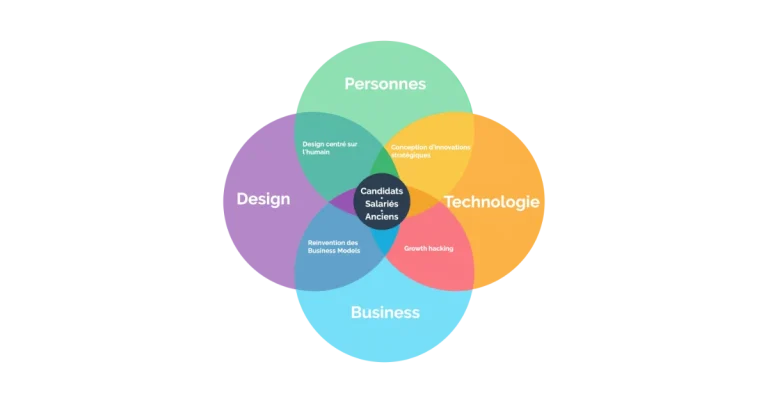
Let me take each one and look at it sideways instead of head-on. My approach here is grounded in HR Design, a human-centric, iterative, collaborative, and prototype-driven process that treats candidates, employees, and alumni as your most demanding clients. The test I run each of these subjects through is simple: is this HR still acting as a process developer and implementer, or is it acting as an experience architect and innovation promoter?
Using trust as a performance lever
Trust is not a soft value. It is an economic metric. Trust is the speed at which decisions circulate inside an organization. Low trust means everything needs three validations, two meetings, and a legal review. High trust means someone says yes and the thing happens. Every organization you have ever worked in has a trust velocity, and you can feel it within a week of joining.
The 2026 numbers make this concrete. According to the Edelman Trust Barometer 2026, surveying nearly 34,000 respondents across 28 countries, 78% of employees trust their employer, making « my employer » the most trusted institution globally, 14 points ahead of business in general and 25 points ahead of government. This is a unique moment in the history of institutional trust. Here is the twist nobody talks about enough. 70% of people are now unwilling or hesitant to trust someone with different values, backgrounds, or sources of information. 42% say they would rather switch departments than report to a manager with different values. 34% say that if their project team leader had different political beliefs than them, they would put less effort into helping them succeed. Trust is concentrated and fragile at the same time.
The prospective angle is uncomfortable. Employers have been handed a historic mandate to act as trust brokers inside increasingly divided societies, and most have no internal playbook for this. The HR function is the one that will have to write that playbook.
The HR Design angle matters here because trust is an experience before it is a metric. It is built in the small, repeated contacts between the organization and its people: a recruitment interview that ends when it said it would, an onboarding that delivers what the recruitment promised, a manager who gives the feedback they said they would give. Collaboration, not participation. The difference is operational. In a participation mindset, you ask employees what they think and then decide for them. In a collaboration mindset, employees are co-authors of the decision itself. Trust regenerates through collaboration and collapses under participation theater.
Adopting an HR posture aligned with company transformation
Alignment is overrated. What organizations actually need is to be slightly, usefully misaligned. HR’s real job during transformation is not to rubber stamp the strategy deck. It is to apply friction where friction is productive. The HR function that says yes to everything is not aligned. It is absent.
The 2026 data reveals how hollow most transformation actually is. Gartner’s research based on 426 CHROs across 23 industries and 4 global regions identified four top priorities for CHROs in 2026, including addressing culture atrophy to power performance. 64% of CHROs say their leaders lack the mindset to guide people through continuous change. Only 32% of leaders have achieved healthy change adoption, but the few that have report double the year-on-year revenue growth of their peers. Even more striking, only one in 50 AI initiatives delivers transformative value, and current workforce reductions are not due to better-performing AI. Only 1% of layoffs in H1 2025 were the result of AI increasing employees’ productivity. Translation: a lot of transformation is theater. Companies are cutting based on promises that have not materialized.
The prospective angle is that HR is about to become the only function legitimate enough to tell the truth about transformation. Finance will give you the numbers. Strategy will give you the narrative. Only HR sees whether the people in the system can actually carry the weight being added to them.
From an HR Design perspective, posture alignment is not about HR adopting business language and business vocabulary until it disappears into the strategy deck. That is the old trap, the one that made HR spend twenty years trying to be taken seriously as a Business Partner and ended up turning HR into a supplier with a nicer job title. HR Design flips the posture. The question is not « how do we align HR with transformation? » but « how do we design transformation so it survives contact with actual human beings? » That is a different job. It requires the iterative, prototype-driven, CEA-centered (Candidates, Employees, Alumni) mindset the profession has avoided for decades because it is slower at the start and faster at the finish.
Clarifying what it means to be an HR Business Partner today
Stop trying to define the role. Start defining the problem the role is solving. The HRBP title is thirty years old, designed for a world of stable org charts and predictable careers. Neither exists anymore. Trying to clarify an obsolete title is like polishing the brass on a sinking ship.
The 2026 landscape makes the old definition impossible to maintain. Josh Bersin describes 2026 as marking a transformational time where HR is undergoing a massive, AI-driven reinvention that moves HR away from administrative overhead and toward a truly strategic, full-stack model. SHRM’s 2026 CHRO Priorities and Perspectives report shows 92% of CHROs anticipate that AI will be further integrated into the workforce this year and 87% forecast greater adoption of AI within HR processes, up from 83% in 2025. In organizations that have implemented AI by 2026, HR professionals said they use AI frequently, with 26% using it weekly, 20% daily, and 9% several times a day. Transactional HR is evaporating. What is left is the part that requires judgment, courage, and context, which is the part the HRBP was always supposed to do but rarely had time for.
The prospective angle is this: by 2028 or 2029, the HRBP who cannot explain, in business terms, what risk they are mitigating and what capability they are building will simply not exist. The AI will absorb everything else.
The HR Design reframe is sharper. The HRBP is not a Business Partner. That title was designed to get HR into rooms it had been excluded from, and it succeeded. But the world has moved. HR Design proposes a different title: Business contributor, which means HR is not supporting the business from the outside but actively creating value from the inside. This is operational, not semantic. A Business contributor designs the candidate experience the way a product manager designs a product. A Business contributor treats the employee journey as a journey that can be mapped, tested, and iterated. A Business contributor considers alumni as a strategic asset, not as ex-employees the payroll system forgot about. The old HRBP asked « how do I support the business? » The HR Design HRBP asks « what experience am I designing, for whom, and what evidence do I have that it works? »
Acting as a strategic partner to managers and the business
You are not a partner until you can say no. Partnership implies the right to disagree. If you cannot refuse a bad idea, you are not a partner, you are a supplier with a nicer job title. This is uncomfortable to say out loud, but it is the distinction that matters.
The 2026 data confirms that HR is being pulled upward whether it wants to be or not. Korn Ferry’s research shows CHROs now spend 33% of their time advising CEO and leadership and another 30% leading company-wide transformation efforts, with talent constraints, digital disruption, and AI adoption now so central to competitiveness that no major business decision should be made without a talent lens. At the same time, an overwhelming majority, 82% of boards and chief executives, said they’ll be reducing up to 20% of their workforces in the next three years because of AI. HR is now in the room where the most consequential workforce decisions of the decade are being made.
From an HR Design perspective, strategic partnership is not a seat at the table. It is a methodology applied to the table. When a CEO proposes a growth plan, the HR Design HRBP does not respond with a list of concerns. They prototype. They bring back three versions of how the workforce could absorb this plan, tested on small populations, with real data from real candidates, employees, and managers. Prototype-driven partnership beats opinion-driven partnership every time. The manager or the CEO does not have to take the HRBP’s word for anything. The prototype speaks.
This is the shift from participation to collaboration at executive level. In the participation mode, HR is invited to comment after the decision is framed. In the collaboration mode, HR helps frame the decision through iterative testing. The evidence from the field is consistent: collaboration produces decisions that stick, participation produces decisions that unravel.
The prospective angle is that the HRBPs who survive this decade will be the ones who can look at a CEO’s growth plan and come back with a testable prototype rather than a PowerPoint of concerns. The ones who cannot will be automated, outsourced, or quietly phased out, regardless of their seniority.
Actively contributing to decisions and value creation
HR often creates more value by subtraction than by addition. The best HR moves of the last decade were things removed. Bad hires caught early. Toxic managers exited. Useless meetings cancelled. Performance review systems retired. Nobody gives awards for subtraction, which is why it rarely happens.
The 2026 evidence is that subtraction is about to become mandatory. Gartner’s future of work research flags workslop, an abundance of fast but poor-quality work produced by or with AI, as organizations’ top productivity drain. The productivity gains promised by AI are being eaten from the inside by the noise AI produces. Gartner also predicts a quarter of candidate profiles could be fake by 2028, which means hiring will increasingly require removing bad signals rather than just sorting good ones.
HR Design pushes the point further. Value creation in HR is not just about adding new programs, new tools, new training catalogues. It is about redesigning the talent cycle so that each stage (attraction, recruitment, inclusion, management, recognition, development, separation, bridging) is measurably better for the people going through it. The data HR sits on is the real dashboard. Absenteeism patterns. Sick leave trends. Exit interview themes. Engagement survey trends tracked over multiple years. The rate at which high performers leave versus the rate at which low performers are promoted. The offer acceptance rate, and more importantly the rate of ghosting between offer and first day. These are not metrics for a yearly report. They are the live feedback loop of a system that should be iterating every month.
The prospective angle is that HR will increasingly be asked to measure things that do not appear on any P&L. The psychological cost of hybrid mandates. The skill atrophy caused by AI tools handling judgment tasks. The trust tax paid every time a layoff is justified with AI productivity claims that do not hold up. The HRBPs who can measure these invisible costs will become indispensable. The ones who cannot will be told they are not strategic enough.
Adapting practices to the evolutions of the world of work
Stop adapting. Adaptation is always reactive. By the time your practices have caught up to the new reality, the new reality has moved again. The companies that win are not the ones that adapt fastest, they are the ones that shape what the next version of work looks like.
The 2026 evidence on how quickly work is mutating is overwhelming. 72% of CEOs expect an increased use of independent contractors, gig workers, and freelancers in 2026, according to SHRM’s 2026 CEO Priorities and Perspectives research. Korn Ferry’s Workforce 2025 survey of more than 15,000 global workers found that while 59% work full-time in the office, only 19% are happy about it, and a quarter say they would be happiest fully remote. The gap between what employers impose and what employees want has become a structural feature of the labor market, not a transition phase. On top of that, AI programs trained on real human workers are giving rise to digital twins or AI avatars already being developed to replicate high-performing employees, and even CEOs, opening uncharted territory in compensation and employees demanding to be paid for ongoing use of their digital likeness.
HR Design offers a different frame. Adaptation is HR responding to the world of work. Design is HR shaping the world of work inside its own organization. The HR Design HRBP does not ask how to implement return to office mandates. They ask what experience the organization wants candidates, employees, and alumni to have over the next ten years, and they prototype their way toward it. This is the whole point of treating employees as clients: clients are not adapted to, they are designed for. When you design for your best clients, they stay. When you adapt to them reactively, they leave for somebody who designed better.
The prospective angle is the boldest of all. By 2030, the companies that treated the future of work as something to adapt to will still be playing catch up. The companies that treated it as something to design will own their category. HR is the architect, or it is the draftsperson. There is no middle option left.
So what actually links these six subjects
There are several ways to link all of them. You could frame everything through the lens of transformation. You could use the word strategic as connective tissue, which is what most conference brochures do. You could invoke the future of work, a phrase that has become the corporate equivalent of saying etcetera. All of these work, in the sense that they fill the time and nobody complains.
None of them are interesting.
The angle: HR as Chief Coherence Officer
Every single one of these six topics is actually about the same thing: coherence.
Trust is coherence between what you say and what you do, tracked over time. Posture alignment is coherence between HR decisions and company strategy. Clarifying the HRBP role is coherence between title and reality. Strategic partnership is coherence across silos. Active contribution to decisions is coherence between capability and responsibility. Adapting to the new world of work is coherence between practice and reality.
The thesis of the webinar becomes this: in a fragmented, accelerating, hybrid, AI saturated world, coherence has become the scarcest resource in organizations. Not agility. Not transformation. Not even talent. Coherence. And the HRBP is the only role structurally positioned to protect it.
The quiet crisis nobody is naming
I am not the first person to use the term. Dave Lütkenhaus has made the case for a Chief Coherence Officer from the angle of strategic integration, and the healthcare strategy community has been circling the same idea for brand and operational alignment. What I want to add here is the HR-specific version: coherence as the scarcest resource in the workforce experience, and the HRBP as the operational architect of it.
The numbers back this up in a way the profession has not yet fully digested. In the Edelman Trust Barometer 2026, business is ranked as more ethical and competent than all other institutions for the first time, with business’s ethics score rising four points to 20 while NGOs fell two points to 17. That is a gift and a trap. Employers now carry the weight of societal coherence that governments and media no longer provide. 74% of people with insular mindsets and 84% of people with open mindsets agree that their employer should broker trust between distrustful groups. There is nowhere else to go.
Inside organizations, a July 2025 Gartner survey of 222 CHROs revealed that only 47% said their culture drives employee performance today. More than half of the people running HR at enterprise scale do not believe their own culture is coherent enough to produce the results the business is asking for. That is the real crisis, and nobody is naming it.
This reframes the profession entirely. HRBPs stop asking « how do we become strategic? », which is a defensive question because it assumes you are not, and start asking « where is our organization losing coherence, and how do we restore it? »
The most interesting way to understand what coherence collapse actually looks like is to study the recent cases where it has already happened.
When words and actions diverge: the Amazon RTO case
In September 2024, Amazon CEO Andy Jassy announced that starting January 2025, the company’s more than 350,000 corporate employees would need to return to the office five days a week. The stated reason was to strengthen culture. The operational effect was the opposite.
A Blind poll of 2,585 Amazon employees taken immediately after the announcement showed 91% were dissatisfied and 73% were considering looking for another job. More than 37,000 employees joined an internal Slack channel organized around remote work advocacy. Gartner’s parallel research found that 80% of employers who have imposed RTO mandates reported losing talent because of them, with high performers, women, and millennials disproportionately leaving. Some future-of-work analysts quoted in Fortune and Bloomberg described the policy as a « layoff wolf in return-to-office sheep’s clothing, » a way to trigger attrition without the reputational cost of formal layoffs.
The coherence failure is not the RTO decision itself. Reasonable people can disagree on office policy. The failure is that the stated reason (strengthening culture) directly contradicts what the mandate produces inside the culture. You cannot strengthen a culture by telling the 73% of people who want to leave that their preferences do not matter. That is not culture-building. That is culture atrophy at scale, executed with a PowerPoint.
From an HR Design perspective, this is textbook top-down infantilization. The decision was imposed, not co-designed. Employees were treated as resources to be placed, not as clients with expectations about their work experience. Had Amazon prototyped this decision with a representative sample of its workforce before announcing it, the feedback loop would have predicted the 73% figure in advance, and the company could have made a different call or made the same call with different framing and different transition support. The tools exist. They were not used.
The only role in the organization positioned to name this contradiction out loud is the HRBP. The ones who named it early, with data, will be the ones who kept their seat at the table. The ones who simply executed are now the ones most exposed when the talent loss lands in the next engagement survey.
When AI promises collide with AI reality: the Klarna case
In 2023, Swedish fintech Klarna announced that its AI assistant, built with OpenAI, could do the work of 700 customer service employees. CEO Sebastian Siemiatkowski made this the centerpiece of a cost-cutting narrative that the tech press amplified for eighteen months.
By mid-2025, Klarna was quietly rehiring. Customer satisfaction had deteriorated on complex interactions. Siemiatkowski admitted publicly that the company had « focused too much on efficiency and cost » and that « the result was lower quality, and that’s not sustainable. » He told Bloomberg, « from a brand perspective, a company perspective, I just think it’s so critical that you are clear to your customer that there will always be a human if you want. »
This is not an isolated incident. Orgvue and Forrester research published in 2025 found that 55% of companies that rushed to replace human workers with AI now regret the decision. Gartner predicts that 50% of AI-driven layoffs will be reversed by 2027, with Forrester adding that most of those rehires will come back offshore or at significantly lower salaries, which is its own coherence problem waiting to explode.
The coherence failure here is structural and recursive. The company said one thing to its public (AI replaces humans). It did a second thing in reality (service quality collapsed). It is now doing a third thing quietly (rehiring, possibly offshore at lower pay). Each step extracts trust from a different stakeholder group: customers, employees, investors, and the next generation of candidates who will read the case study before accepting an offer.
The HR Design lesson is direct. Klarna treated the 700 customer service employees as a cost line, not as the designed interface between the company and its clients. A company that considers « employee centered, client focused » to be a real operational principle could not have made this decision the way Klarna did, because the two halves of that principle would have been in visible tension from day one. The HRBP who could have modeled the service quality risk before the headcount decision, or who could have named the rehiring cost honestly at the time of the layoff, would have saved Klarna from becoming the canonical cautionary tale of 2026.
Add to this Gartner’s emerging workslop category, the abundance of fast but poor-quality output produced by or with AI that employees then spend hours fixing. The AI productivity story and the AI reality are diverging in real time inside most organizations. HRBPs who cannot measure that gap will be unable to defend the workforce from it, and by extension unable to defend the business from the rehiring bill that follows.
When safety culture becomes a slogan: the Boeing case
On January 5, 2024, a door plug blew out of an Alaska Airlines Boeing 737 MAX 9 at 16,000 feet over Oregon. No one was killed. The investigation that followed was a coherence post-mortem at civilizational scale.
The NTSB concluded in June 2025 that the probable cause was Boeing’s failure to provide adequate training, guidance, and oversight to its factory workers, and that Boeing’s voluntary safety management system was inadequate and did not proactively identify and mitigate risks. The pattern underneath was worse than the incident itself. Whistleblowers including engineer Sam Salehpour and quality investigator Sam Mohawk had flagged systemic problems for years. One earlier whistleblower, John Barnett, died by suicide during a lawsuit alleging retaliation. Senator Richard Blumenthal said at a 2024 Senate hearing that this is a culture that enables retaliation against those who do not submit to the bottom lines.
Boeing agreed to pay up to $487 million to settle fraud charges related to the earlier MAX crashes. The FAA added a $3.1 million fine in September 2025 for the door plug violations. The reputational and operational damage runs well beyond those numbers.
The coherence failure is total. Boeing’s stated safety culture and its operational safety practices had been divergent for years. Every HR system that should have caught the divergence, whistleblower processes, manager escalation paths, retaliation protections, exit interview patterns, was itself part of the failure. This is the extreme case every HRBP should keep on their desk. The gap between a stated value and the operational reality of that value is never safe to ignore. Culture atrophy does not announce itself. It accumulates quietly, and then something falls off a plane.
When law forces coherence: the pay transparency wave
By early 2026, fourteen US states plus Washington DC have active pay transparency laws covering roughly 60 million workers, with more states joining through 2026 and 2027. Illinois, Minnesota, Massachusetts, New Jersey, and Vermont all saw new laws take effect in 2025. Delaware’s law kicks in September 2027. Research from Beqom estimates that roughly half of all US workers will be covered by pay transparency laws by the end of 2026 if current trends continue.
The point of these laws is not really compliance. It is forced coherence. For decades, companies have told employees one story about how pay is determined while quietly running a different system underneath. When a law requires a public salary range on every posting, the gap between the story and the system becomes visible to everyone at once. Payscale’s 2025 Fair Pay Impact Report found that 51% of employees disagree or strongly disagree that their employer is transparent about compensation. That is the coherence gap, measured directly, before the laws have even fully landed.
The prospective angle is that legislation is doing to pay what public markets did to financial reporting thirty years ago. Everything will be visible. The HRBPs who can build a compensation system that stands up to public scrutiny, and who can explain it to employees in plain language, will become indispensable. The ones who cannot will spend the next five years managing reputational damage, internal disputes, and attrition caused by the coherence gap going public all at once.
Why HR is the only role structurally positioned for this
Step back from these four cases and look at what they share. In each one, the data that would have exposed the incoherence earlier existed somewhere in HR. Amazon’s HR function had engagement data before the RTO mandate. Klarna’s HR function had service quality trend lines that could be correlated with staffing changes. Boeing’s HR function had whistleblower complaints, retaliation reports, and exit interview patterns going back years. Every pay transparency reveal has a compensation audit trail already sitting in the HRIS.
HR is the only function that sits on the full dataset of how an organization actually operates, as distinct from how it describes itself. Finance sees the money. Strategy writes the narrative. Operations runs the machine. HR sees the gap between the narrative and the machine, measured in the behavior of humans. That gap is coherence, or its absence. No other function has both the data and the access.
The Edelman Trust Barometer 2026 makes this even sharper. Employers are now expected to act as trust brokers in societies that have lost faith in government and media. 73% of people say the CEO is expected to lead this, with publicly endorsed strategies that include consulting people with different values and backgrounds when making decisions (75%) and constructively engaging with employees who criticize the company (74%). There is nowhere else to go. The HRBP is, whether the role wants to admit it or not, the operational architect of that trust-brokering capacity.
The new HRBP scorecard
The prospective angle is specific. Over the next three to five years, the HRBP function will be measured on a different dashboard than the one most of the profession uses today. The metrics that matter will be coherence metrics.
The gap between employee survey results and public employer brand claims. The gap between stated promotion criteria and actual promotion patterns. The gap between AI productivity claims and the skill atrophy data inside the workforce. The gap between the company’s stated values and the decisions that get approved at the executive committee. The gap between what the CEO says on all-hands calls and what leaves the building in exit interviews. The gap between what your compensation system says and what your public job postings now have to reveal.
None of these metrics exist on a standard HR dashboard in 2026. By 2030, the HRBPs who have built them will be irreplaceable. The ones who have not will be quietly replaced by AI agents handling the transactional work, because no one will be able to point to the distinctive value they add.
The HR Design discipline is the operating system for this new scorecard. Iterative because coherence is never solved once and for all, it is maintained loop by loop. Collaborative because coherence cannot be imposed top-down, it has to be co-designed with the people who will live inside it. Prototype-driven because saying what should be coherent is easy, showing it in a tested, measurable form is the actual job. Human-centric because candidates, employees, and alumni are the ones who detect incoherence first, long before it shows up in the P&L.
That is the job. Everything else is a dish on the menu.
How can I help you
… with HR posture aligned with company transformation challenges
The six subjects of this brief all converge on the same operational question: how do you design an HR function that produces coherence instead of defending against its collapse? I work with leadership teams and HR organizations on exactly this. Two formats, depending on what the organization needs first.
Conference
A ninety-minute keynote built around the Chief Coherence Officer thesis, with the four cases above expanded with live Q&A. Designed for HR leadership events, management conventions, and executive committees. The audience leaves with a diagnostic framework to audit their own organization’s coherence gaps, the specific 2026 data points that matter, and a short list of questions to bring back to their own executive committee the following Monday. Adaptable from 45 minutes to half a day depending on the format. Available in English and French.
Workshop
A two-day intensive for HR teams ready to move from diagnosis to design. Day one builds the coherence audit: mapping the gaps between what the organization says and what it does, using the HR Design toolkit (candidate journey, employee experience mapping, DNA check-up, sourcing model canvas, and others). Day two runs the first prototype cycle: each participant leaves with one specific coherence initiative, designed collaboratively, ready to test in their own team within thirty days. Structured for HR functions of between ten and fifty people, adaptable for smaller or larger groups. Available in English and French.
If either format matches a challenge you are working on, or if you want to design something specific for your context, reach out through my contact page.
This post will move to my Australian website as soon it’s been redesigned