Pourquoi le « HR business partner » cède la place au « business contributor »
Pendant trente ans, le titre de « HR business partner » a été le plus beau compliment adressé à une fonction RH. Il donnait accès à une place à la table des dirigeants et à une voix dans la définition de la stratégie. Il prouvait le passage des RH de l’administration à l’influence.
Cet article pose la posture qui traverse tout mon travail sur le HR Design, l’approche centrée sur l’humain, itérative, collaborative et fondée sur le prototype que je développe depuis 2020. Il explique ce qui change quand les RH passent du soutien au business à la création de valeur au sein du business, et les gestes concrets à engager dès ce trimestre pour y parvenir.
| Le titre hérité | Ce qui le plafonne | Le déplacement |
|---|---|---|
| Le HR business partnerLe HR business partner traduit une stratégie décidée ailleurs en décisions sur les personnes. Ce rôle a longtemps marqué l’accès de la fonction RH à la table des dirigeants. | Un rôle absorbé et dépasséL’IA agentique absorbe une large part du travail d’exécution, et les dirigeants attendent désormais une lecture des capacités de l’organisation plutôt qu’un suivi de l’engagement. | Du partenaire au contributeurLe business contributor apporte à la stratégie ce qui n’existerait pas sans la fonction RH : la prévision des capacités, l’architecture de l’expérience et le diagnostic de cohérence. Le changement relève de la posture, sans nouveaux effectifs ni nouveau budget. |
HR business partner n’est que le point de départ
Le titre de HR business partner a longtemps servi de ligne d’arrivée à la fonction RH. Il en devient le point de départ, parce que cinq forces le repoussent : la consumérisation du travail, l’arrivée de l’IA agentique, le déplacement du regard des dirigeants, la transparence des rémunérations et le renouvellement démographique. Chacune exige de la fonction RH une contribution que le rôle de partenaire ne prévoit pas.
La consumérisation du travail
Les candidats et les salariés attendent désormais de leur employeur la même fluidité que celle de leur application bancaire. Ils comparent votre formulaire de candidature à une commande de repas passée à minuit, et vos outils internes aux produits grand public qu’ils utilisent le week-end. L’écart se lit dans les taux d’acceptation des offres, dans les départs au cours des six premiers mois et dans les avis publics que les candidats rédigent sur les processus de recrutement avant même de signer leur contrat.
Le partenaire s’adapte à ces attentes. Le contributeur conçoit une expérience à leur hauteur.
L’arrivée de l’IA agentique
Les outils génératifs et agentiques ont absorbé une large part du travail des HR business partners : répondre aux questions sur les règles internes, rédiger les offres d’emploi, extraire des analyses et orienter les demandes des managers. Aucune de ces tâches n’exige aujourd’hui un professionnel RH expérimenté.
Le travail que l’IA ne sait pas faire en exige un : lire la culture, identifier les incohérences de l’organisation et décider de ce qui mérite d’être mesuré. Le rôle de partenaire s’est construit autour du travail d’exécution. Le rôle de contributeur se construit autour du travail de jugement.
Le déplacement du regard des dirigeants
Les conseils d’administration traitent désormais les données sur les équipes avec le même sérieux que le compte de résultat. L’enquête 2026 de la CHRO Association le dit sans détour : 91 % des DRH interrogés classent l’IA et la digitalisation du travail en tête de leurs préoccupations immédiates, loin devant la gouvernance, l’engagement et les talents. Cette enquête américaine, menée auprès d’environ 150 DRH de grandes entreprises, décrit un contexte qui ne se transpose pas tel quel en France.
Elle signale pourtant un changement de la question posée aux RH. La question « quel est le niveau d’engagement des équipes ? » laisse place à une autre : « que savent réellement faire nos équipes, et à quelle vitesse peuvent-elles s’adapter ? ». Le partenaire répond à la première question. Le contributeur répond à la seconde.
La transparence des rémunérations
La directive européenne sur la transparence des rémunérations fait passer les règles de rémunération du bureau des RH à la vue de tous. Elle oblige l’employeur à communiquer la rémunération initiale ou sa fourchette avant l’embauche et lui interdit de demander au candidat son historique de salaire. Elle donne aussi à chaque salarié le droit de connaître les niveaux de rémunération moyens, ventilés par sexe, des personnes qui effectuent un travail de même valeur, et elle impose une évaluation conjointe avec les représentants du personnel quand un écart d’au moins 5 % reste injustifié. Les États membres devaient appliquer ces règles au plus tard le 7 juin 2026.
Le partenaire applique une grille de rémunération. Le contributeur doit pouvoir la justifier devant chaque salarié, ce qui suppose une architecture des emplois et des critères objectifs que beaucoup d’entreprises n’ont jamais formalisés.
Le renouvellement démographique
L’exercice Les métiers en 2030 de France Stratégie et de la Dares projette près de 800 000 postes à pourvoir chaque année en France entre 2019 et 2030, dont environ 90 % liés au remplacement des seniors qui partent en fin de carrière. Les compétences qui quittent l’entreprise avec eux se remplacent rarement par un simple recrutement, parce qu’une partie de ces savoirs n’a jamais été écrite.
Le partenaire remplace les départs poste par poste. Le contributeur anticipe les savoirs qui partent, organise leur transmission et décide lesquels l’entreprise doit reconstruire autrement.
Ce que « business contributor » veut vraiment dire
Dans le cadre d’origine du HR Design, j’écrivais que cette approche transforme les RH, qui passent de concepteurs et d’exécutants de processus à architectes de l’expérience et promoteurs de l’innovation. J’écrivais aussi que les RH deviennent une composante essentielle du business et qu’avec le design en tête, elles dépassent les rôles de business partner ou de business contributor pour devenir business creator.
Six ans plus tard, je veux être plus précis. Partenaire, contributeur et créateur désignent trois rôles réellement différents, et la distinction compte parce qu’elle décide de l’emploi de votre semaine. Chaque niveau correspond à une relation différente au business, bien plus qu’à un intitulé de poste différent.
Partenaire, contributeur et créateur
Le business partner traduit la stratégie de l’entreprise en décisions sur les personnes. La stratégie vient d’ailleurs et les RH aident à l’exécuter.
Le business contributor apporte à la stratégie un élément qui n’existerait pas sans la fonction RH. Cet élément tient en une lecture lucide de trois questions : les compétences que l’entreprise peut construire de façon crédible, celles qu’elle ne peut pas construire et les expériences qui décideront de la survie de la stratégie au contact du réel. La connaissance des équipes devient une donnée d’entrée de la planification de l’entreprise, au lieu d’une diapositive ajoutée à la fin.
Le business creator génère un chiffre d’affaires ou une marge directement à partir de la fonction RH. Le Disney Institute, Porsche Consulting et les académies du système de production Toyota en sont les références historiques. La direction des ressources humaines de Jean-Louis Motel chez Evolution a généré 2 millions d’euros en vendant formations et méthodes à des clients. Ces cas restent rares, et ils méritent d’être suivis parce qu’ils montrent ce qui se passe quand une fonction RH attribue à son expertise une valeur sur le marché extérieur.
Pourquoi le contributeur est la cible réaliste
Pour la plupart des organisations, le passage de partenaire à contributeur est le plus urgent. Le rôle de créateur reste une aspiration de long terme, qui suppose de disposer d’une offre que le marché extérieur accepte de payer, et la plupart des fonctions RH n’en sont pas encore là.
Le rôle de contributeur, lui, s’atteint dès cette année. Il s’obtient sans nouveaux effectifs ni nouveau budget, par un changement de posture. Le cadre du HR Design a été conçu précisément pour rendre ce changement possible, et la section suivante le décompose en cinq déplacements concrets.
Cinq déplacements qui font d’un partenaire un contributeur
Déplacement 1 : de la réponse à l’anticipation
Le partenaire réagit à la commande. Le contributeur l’interroge.
Dans le HR Design, la phase d’inspiration existe exactement pour cette raison. Avant de lancer une enquête ou de dessiner un persona, la question elle-même doit être questionnée. J’ai emprunté cette discipline à Tim Brown et Jocelyn Wyatt, qui avertissaient qu’une commande trop prescriptive conduit presque à coup sûr à un résultat incrémental et médiocre.
Un partenaire reçoit une commande qui dit « réduire le turnover de 5 % ». Un contributeur la reformule : « quelle expérience nos salariés quittent-ils, et quelle version de cette expérience choisiraient-ils activement pour rester ? ». La première version produit une prime de fidélisation. La seconde produit une offre repensée.
La reformulation va bien au-delà des mots. Elle change le public visé (des partants vers les salariés actuels et futurs), l’horizon de temps (du trimestre au continu), le propriétaire du budget (souvent partagé avec les opérations) et l’indicateur de réussite (du taux de turnover à un indicateur de qualité de l’expérience que l’équipe définit elle-même).
Déplacement 2 : de la marque employeur à l’architecture de l’expérience
La marque employeur est une transaction. L’architecture de l’expérience est une offre.
La plupart des budgets de marque employeur financent encore des supports de communication qui promettent ce que l’expérience vécue ne peut pas tenir. Le résultat porte un nom dans mon travail : l’écart de consumérisation. Les candidats comparent leur parcours de candidature à une commande de repas passée à minuit, et les salariés comparent leurs outils internes aux applications grand public du week-end. L’écart se lit dans les taux d’acceptation des offres, dans les départs des six premiers mois et dans l’habitude désormais courante des candidats de noter publiquement les processus de recrutement sur les réseaux sociaux avant de signer.
Le contributeur réduit cet écart en traitant l’ensemble du Talent Cycle Wheel (la roue du cycle du talent) comme un seul projet d’architecture. L’attraction, le recrutement, l’inclusion, le management, la reconnaissance, le développement, la séparation et le lien après le départ forment les étapes d’une même expérience continue, que l’entreprise conçoit délibérément ou improvise mal. Le Sourcing Model Canvas, le DNA Check-up et le Meaning and Purpose Set-up sont les outils que j’utilise pour rendre cette architecture explicite.
Déplacement 3 : de la productivité individuelle à l’intelligence institutionnelle
L’IA impose ce déplacement plus vite que tous les autres, et la plupart des fonctions RH le ratent.
Le réflexe dominant consiste à donner à chaque salarié un copilote IA et à mesurer les gains de productivité individuels. Brandon Sammut, directeur des ressources humaines et de la transformation IA de Zapier, explique clairement pourquoi ce réflexe cale. Il parle de plafond de l’IA institutionnelle : quelqu’un construit un usage utile de l’IA et personne d’autre n’en profite, si bien que la valeur reste bloquée au niveau individuel. La réponse de Zapier a consisté à demander à chacun de ses onze services de livrer, à chaque trimestre de 2026, une nouvelle façon significative de travailler avec l’IA, soit quarante-quatre cas partagés en une seule année.
Le travail du contributeur consiste à concevoir les rituels, les espaces d’échange et les incitations qui transforment des expériences privées avec l’IA en capacité partagée. Il s’agit de collaboration au sens strict où je l’ai toujours définie dans le HR Design, bien au-delà de la participation et de la coopération : une collaboration réelle, où n’importe qui peut lancer une idée et où les décisions se prennent ensemble.
Voici un test rapide. Dans votre entreprise, un salarié du marketing peut-il apprendre d’un usage de l’IA construit par un collègue de la finance sans lui envoyer de message sur Slack ? Si la réponse est non, vous disposez d’un système de participation au lieu d’un système de collaboration, et votre investissement dans l’IA perd de la valeur.
Déplacement 4 : des enquêtes d’engagement à la prévision des capacités
Les enquêtes d’engagement demandent aux gens ce qu’ils ressentent. La prévision des capacités demande ce que l’organisation sait faire.
Steve Holdridge, de Dayforce, décrit l’élévation des données RH aux plus hauts niveaux de décision de l’entreprise. Selon lui, les données sur les personnes rivaliseront en 2026 avec les données financières en importance stratégique. La vision des équipes passe d’un historique des effectifs et des coûts à une carte vivante des capacités, de l’agilité et du potentiel opérationnel.
Ce déplacement relève de la posture bien plus que du logiciel. Le contributeur cesse de présenter le score d’engagement du dernier trimestre et présente la prévision des capacités du trimestre suivant : les compétences qui prennent de la valeur, celles qui en perdent, les postes où la relève manque et les endroits où les appétences de l’équipe rejoignent, ou non, les besoins émergents du business.
Certains lecteurs reconnaîtront ici mon travail de longue date sur la grille anti-obsolescence. Cette grille rend la prévision concrète au niveau individuel. Agrégée à l’échelle des équipes, elle devient une lecture de la durabilité de l’organisation que les dirigeants peuvent mettre à l’ordre du jour d’un conseil d’administration.
Déplacement 5 : du propriétaire de processus au garant de la cohérence
Je développe dans mon prochain livre sur le HR Design l’idée des RH comme Chief Coherence Officer. En voici la version courte.
Le partenaire possède des processus. Le contributeur répond de la cohérence entre ce que l’entreprise dit, ce qu’elle fait et ce que les gens vivent réellement.
Dans un monde passé du VUCA au BANI, où les salariés doivent être à la fois autonomes et alignés, à distance et présents, productifs et créatifs, la ressource rare devient la cohérence, bien plus que l’effort. Cette cohérence se joue entre la promesse de marque et le processus de recrutement, entre les valeurs affichées au mur et les critères de l’entretien annuel, entre le discours sur l’innovation et la tolérance aux expériences ratées, et entre ce pour quoi un manager est récompensé et ce dont son équipe a réellement besoin.
Le rôle du contributeur consiste à rendre ces incohérences visibles, à les identifier et à proposer des refontes qui les réduisent. Aucun agent d’IA ne peut tenir ce rôle, parce que la cohérence relève d’un jugement ancré dans la lecture de la culture, bien plus que d’un motif détecté dans les données.
L’échelle du HR Design : un autodiagnostic
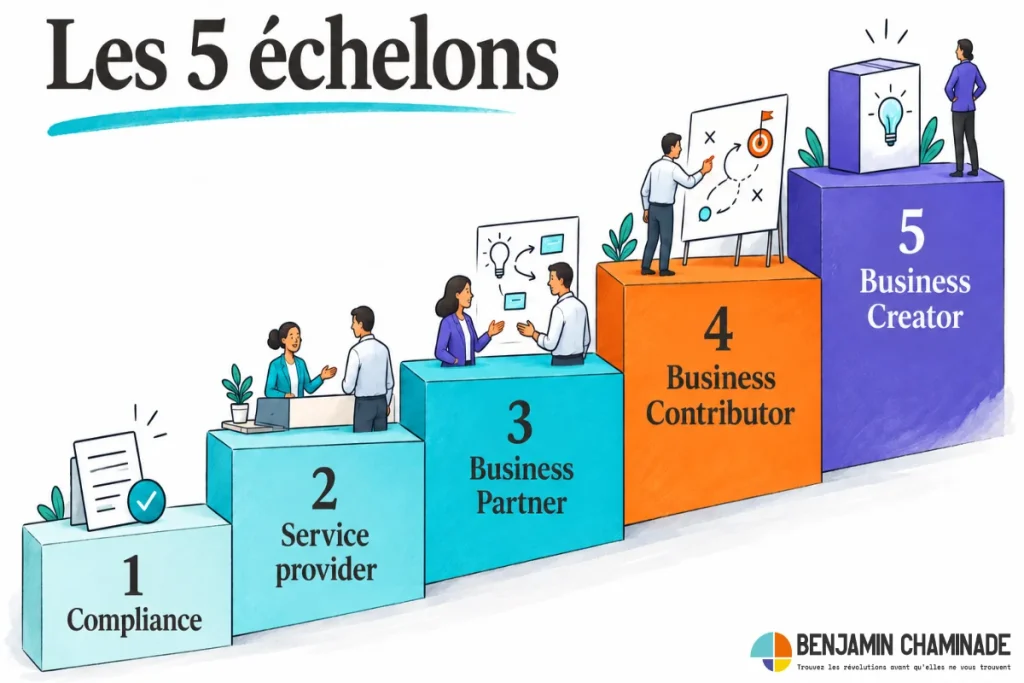
Les cinq déplacements ne se produisent pas d’un coup et suivent une progression. Pour rendre cette progression utilisable, j’ai construit une échelle à cinq échelons qui aide toute fonction RH à se situer aujourd’hui et à identifier sa prochaine étape réaliste. Cette échelle sert aussi de base à mon autodiagnostic en vingt questions, disponible en anglais.
Les cinq échelons
Échelon 1, la conformité
Les RH existent pour protéger l’entreprise sur le plan juridique. L’activité est dominée par les contrats, la paie, le traitement des litiges et le reporting.
Cet échelon reste indispensable, et il ne cesse de s’alourdir. En France, toute entreprise d’au moins 50 salariés doit publier chaque année, au plus tard le 1er mars, son index de l’égalité professionnelle, sous peine d’une pénalité pouvant atteindre 1 % des rémunérations versées. La fonction RH qui s’arrête à cet échelon calcule l’index, le publie et passe à l’obligation suivante, sans jamais s’en servir pour éclairer une décision.
Échelon 2, le prestataire de services
Les RH gèrent un catalogue de services comme le recrutement, la formation et les avantages sociaux. Les clients internes déposent des demandes et reçoivent des livrables.
L’efficacité y devient l’indicateur roi : délais de traitement, coût par bulletin de paie et satisfaction des demandeurs. Au Royaume-Uni, le gouvernement prévoit de regrouper les fonctions RH, paie et finance de ses ministères dans cinq centres de services partagés, au service de plus de 450 000 fonctionnaires. Le National Audit Office a relevé que les stratégies précédentes n’avaient pas produit les économies attendues, et l’échéance du programme a glissé de 2025 à 2028.
L’exemple montre la limite de l’échelon : un service mieux organisé reste un service, et son succès se mesure d’abord à ce qu’il coûte.
Échelon 3, le business partner
Les RH sont intégrées aux unités opérationnelles, traduisent la stratégie en plans RH et sont consultées sur les décisions d’organisation.
Ce modèle, formalisé par Dave Ulrich à la fin des années 1990, reste la norme dans les grandes entreprises. Une offre de GE Vernova pour un Lead HR Business Partner basé à Orsay en donne une description fidèle : premier interlocuteur des salariés et des managers, le titulaire exécute la politique et la stratégie RH et travaille avec une certaine autonomie, dans le cadre de pratiques, de précédents et de politiques bien définis. Le rôle se tient près du terrain et connaît les enjeux de son unité. Sa limite tient à l’origine de la stratégie, qui reste extérieure à la fonction RH.
Échelon 4, le business contributor
Les RH façonnent la stratégie en apportant des prévisions de capacités, une architecture de l’expérience et des diagnostics de cohérence que les autres fonctions ne savent pas produire. Leurs travaux changent ce que l’entreprise décide, au-delà de la manière dont elle exécute ses décisions.
Schneider Electric en offre un exemple français. Le groupe a lancé en 2020 son Open Talent Market, une place de marché interne qui s’appuie sur l’IA pour rapprocher les compétences et les ambitions des salariés des postes, des missions à temps partiel, du mentorat et des formations disponibles. La fonction RH y produit une lecture des compétences disponibles dans le groupe que ni la finance ni les opérations ne savent produire.
Échelon 5, le business creator
Les RH génèrent un chiffre d’affaires ou une marge externes en transformant leur expertise en offre.
Renault Group s’en approche avec ReKnow University, son université d’entreprise, dont les formations s’adressent aux salariés du groupe, aux partenaires de la filière, aux jeunes en formation initiale et aux demandeurs d’emploi. Le groupe visait 35 000 personnes formées d’ici 2025. L’expertise construite pour transformer ses propres équipes devient ainsi une ressource pour tout son écosystème, même si le groupe ne publie pas le chiffre d’affaires qu’elle génère.
Où se situent réellement la plupart des fonctions RH
La plupart des fonctions se situent entre les échelons 2 et 3 et visent l’échelon 4. L’aspiration est réaliste. Le chemin est rarement linéaire, et sauter des échelons produit le plus souvent une fonction qui parle comme l’échelon 4 tout en fonctionnant comme l’échelon 2.
Le schéma que je rencontre le plus souvent porte un nom : le « syndrome de l’échelon 3,5 ». La fonction RH emploie le bon vocabulaire (expérience, capacité, contribution et cohérence), mène les bonnes initiatives (programmes d’expérience collaborateur, pilotes d’IA et référentiels de compétences) et fonctionne pourtant comme un prestataire dès qu’une urgence arrive sur le bureau. Le vocabulaire change plus vite que la posture. Réduire cet écart constitue le vrai travail, qui prend en général entre douze et dix-huit mois.
Retour terrain
Le DRH qui vendait ses méthodes
Parmi les directeurs des ressources humaines que j’ai accompagnés, Jean-Louis Motel, aujourd’hui à la retraite, a conduit la fonction RH d’Evolution jusqu’au dernier échelon de cette échelle. Sa direction des ressources humaines vendait à des clients les formations et les méthodes qu’elle avait d’abord construites pour ses propres équipes, et elle a généré ainsi 2 millions d’euros.
Ce chiffre compte moins pour son montant que pour ce qu’il démontre. Une méthode qu’un client extérieur accepte de payer quitte la catégorie des coûts de structure et rejoint celle des actifs de l’entreprise. La fonction RH qui la porte arrive devant les dirigeants avec une preuve venue du marché, là où la plupart des fonctions RH arrivent avec un budget à défendre. Le cas reste rare, et il éclaire toute l’échelle : chaque échelon se franchit quand la fonction RH produit ce que les autres fonctions ne savent pas produire.
Le rôle de business creator commence par une question simple, à poser à chaque outil RH construit en interne : un client extérieur accepterait-il de le payer ?
Ce que le HR Design apporte de plus que les autres approches
Plusieurs approches prétendent moderniser les RH : le design thinking appliqué aux RH, les RH agiles, les plateformes d’expérience collaborateur et la réinvention de la rémunération globale. Chacune a ses mérites et aucune ne suffit seule. Le HR Design se présente comme une synthèse construite pour la fonction RH, plutôt que comme un cadre concurrent, avec deux traits distinctifs que les autres approches manquent régulièrement.
Un public pluriel
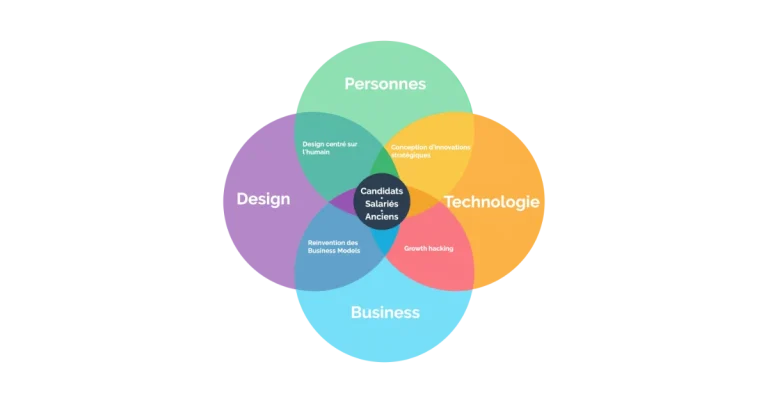
Le HR Design oblige la fonction à concevoir pour trois populations au lieu d’une. Les candidats, les salariés et les anciens salariés forment des groupes distincts, aux besoins qui se recoupent sans se confondre. La plupart des initiatives RH ne visent que le deuxième groupe, parfois une partie seulement de ce groupe. Le HR Design traite les trois comme des publics légitimes, chacun avec sa propre expérience à concevoir.
Cela inclut les anciens salariés qui deviendront prescripteurs, candidats au retour ou clients. Cela inclut aussi les non-candidats, dont le silence constitue le signal le plus fort de votre stratégie d’attraction. Si vos seules données sur les candidats viennent de ceux qui ont déjà postulé, vous travaillez avec un biais du survivant qu’aucune campagne de marque employeur ne corrigera.
La discipline du prototype
Le business contributor présente un prototype fonctionnel à la place d’un plan de transformation de trente pages : un nouveau rituel d’intégration, un entretien de carrière repensé ou un outil de mobilité interne assisté par l’IA. Il l’améliore ensuite de façon visible avec les personnes concernées. Le prototype est le livrable et le plan en est le résidu.
Le HR Design emprunte ici le plus directement au Lean Startup et au growth hacking : construire petit, tester vite et apprendre en public. La fonction RH qui adopte cette discipline quitte la place du service le plus lent de l’entreprise pour rejoindre celle des plus rapides à apprendre.
Cinq gestes concrets à engager ce trimestre
Les cinq déplacements et l’échelle aident à penser, sans suffire à changer quoi que ce soit d’ici vendredi. La liste ci-dessous convertit le cadre en cinq gestes à lancer cette semaine, sans nouveau budget, sans validation de la direction générale et sans achat de logiciel. Ils sont volontairement modestes, parce que la discipline du prototype impose de commencer petit.
Les gains rapides
- Mener un audit de cohérence sur une expérience : choisissez un seul moment du cycle du talent (le premier entretien d’un candidat, la première semaine d’un nouveau salarié ou un entretien de départ). Cartographiez ce qui est promis, ce qui est livré et ce qui est ressenti. L’écart constitue votre point de départ.
- Choisir une expérience d’IA et l’institutionnaliser : trouvez un usage de l’IA déjà en place quelque part dans l’entreprise et transformez-le en pratique partagée, documentée et transmissible. Mesurez sa diffusion plutôt que le gain individuel.
- Remplacer une question d’engagement par une question de capacité : au lieu de demander « quel est votre niveau d’engagement sur une échelle de 1 à 10 ? », demandez « de quelle compétence, absente aujourd’hui, aurez-vous besoin dans votre poste dans douze mois ? ». Les réponses sont immédiatement exploitables.
Les gestes de fond
Rédiger une thèse de contribution d’une page : que votre fonction RH apporte-t-elle à la stratégie qui n’existerait pas sans elle ? Si vous ne parvenez pas à l’écrire en une page, vous ne la tenez pas encore.
Coconcevoir un rituel avec les personnes qu’il concerne : une revue mensuelle, un moment de reconnaissance ou un format de réunion. Appliquez la logique de collaboration plutôt que celle de participation. La commande reste ouverte et la décision est partagée.
Comment je peux vous aider à devenir business contributor
Lire un article est une chose, et déplacer la posture d’un CODIR ou d’une équipe RH en est une autre. Au fil des six dernières années, j’ai affiné deux formats qui traduisent le cadre du HR Design en action : une conférence pour les équipes de direction qui doivent s’aligner sur le cap, et un atelier pour les équipes RH prêtes à prototyper. Les deux sont conçus pour que chacun reparte avec des décisions concrètes plutôt qu’avec des diapositives.
La conférence : du partenaire au contributeur
Il s’agit d’une conférence de 60 à 90 minutes pour les CODIR, les équipes de direction et les congrès RH. Elle déroule les cinq déplacements, l’échelle et le contexte qui rend le changement urgent. Elle est conversationnelle, illustrée de cas concrets issus de ma pratique de conseil, et se termine par un échange ouvert avec la salle.
Elle fonctionne particulièrement bien en ouverture d’un séminaire RH, d’une retraite de direction ou d’un lancement de transformation. Son but consiste à donner à la salle un vocabulaire et un diagnostic communs, pour que le travail qui suit ait une chance d’être cohérent, bien plus qu’à convaincre qui que ce soit d’adopter un nouveau cadre.
Formats possibles : conférence en présentiel, à distance ou en format hybride. Langues disponibles : français et anglais. La conférence existe aussi en version enregistrée pour les communautés RH internes.
L’atelier : concevoir votre contribution
Il s’agit d’un atelier d’une ou deux journées pour des équipes RH de 8 à 20 personnes, prêtes à appliquer le cadre du HR Design à un enjeu précis de leur organisation. L’atelier s’articule en trois séquences :
- situer la fonction sur l’échelle, à l’aide de l’autodiagnostic et d’un débriefing collectif structuré ;
- choisir l’un des cinq déplacements à travailler, en croisant le score le plus faible de l’équipe et la priorité business la plus forte ;
- et prototyper en temps réel le premier geste, avec les outils du HR Design adaptés (DNA Check-up, Sourcing Model Canvas, cartographie du Talent Cycle Wheel ou Meaning and Purpose Set-up).
À la fin de l’atelier, chaque participant repart avec un prototype concret, un plan à 90 jours et un diagnostic partagé que l’équipe peut utiliser pour s’aligner avec le CODIR. L’atelier fonctionne comme un sprint de coconception, bien plus que comme une session de formation.
Formats possibles : atelier sur site, atelier à distance en deux demi-journées, ou format mixte avec un diagnostic à distance et une journée de prototypage en présentiel. Langues disponibles : français et anglais.
Comment engager la conversation
Si l’un de ces formats correspond à votre équipe ou à votre événement, écrivez-moi depuis la page de contact ou contactez-moi directement sur LinkedIn. Je vous enverrai un court questionnaire de cadrage pour vérifier que le format convient à votre contexte, puis je vous proposerai une session conçue pour votre situation plutôt que copiée sur la transformation d’une autre entreprise.
Ce que cela signifie pour la suite de mon travail
Cet article s’inscrit dans un ensemble plus large. Chacun des cinq déplacements rejoint d’autres articles, outils et cadres que je développe dans mon travail de conseil et d’écriture. Si un point vous parle ici, les articles liés approfondissent chaque facette du rôle de contributeur. Ils paraîtront prochainement sur mon site australien.
Les articles liés
Côté candidats, mon travail sur la consumérisation du recrutement, l’expérience des non-candidats et la segmentation entre candidats et non-candidats prolonge l’étape d’attraction du Talent Cycle Wheel.
Côté salariés, le Donut managérial, le canevas de fragilité et mes contenus sur le leadership régénératif traitent le management, la reconnaissance et le développement.
Côté anciens salariés, mon travail sur le bridging et la gestion de la relation avec les alumni referme une boucle que la plupart des entreprises traitent encore comme une porte de sortie au lieu d’un pont ouvert.
L’idée du Chief Coherence Officer relie l’ensemble. Chaque article en éclaire une facette, et tous posent la même question : que faut-il à la fonction RH pour contribuer au business, au-delà du simple soutien ?
Poursuivre la conversation
Je continuerai à mettre à jour cet article au fil de l’évolution de la pratique. Si un point vous parle, contredit votre expérience ou soulève une question que vous aimeriez me voir traiter, écrivez-moi. Les articles les plus utiles de cette série sont nés d’objections de lecteurs.
Avant de fermer cet onglet, prenez cinq minutes pour situer votre fonction sur l’échelle avec l’autodiagnostic. Vous saurez à quel échelon elle se trouve, lequel des cinq déplacements travailler en premier et quoi faire dès la semaine prochaine.
La posture à l’épreuve de l’innovation
Envie de voir le contributeur au travail sur un terrain précis ? Découvrez comment la fonction RH décide de la nouveauté qui entre et dure dans l’entreprise, dans l’article sur le rôle du RH dans l’innovation, la suite logique de celui-ci.
Benjamin Chaminade travaille au croisement des RH, du design et de l’innovation depuis 2003. Il est l’auteur de HR Design et de plusieurs autres livres sur les talents, le management et la marque employeur. Le cadre complet du HR Design, dont le Talent Cycle Wheel, le DNA Check-up et plus de 150 outils, sera bientôt disponible sur reboot-lab.com.
Questions fréquentes sur le HR business partner
Qu’est-ce qu’un HR business partner ?
Un HR business partner est un professionnel RH rattaché à une unité opérationnelle, chargé de traduire la stratégie de l’entreprise en décisions sur les personnes : recrutement, organisation, compétences et accompagnement des managers. Le rôle a ouvert aux RH l’accès à la stratégie, tout en restant un rôle d’exécution d’une stratégie décidée ailleurs.
Quelle différence entre HR business partner et business contributor ?
Le HR business partner traduit la stratégie en plans RH. Le business contributor apporte à la stratégie un élément qui n’existerait pas sans la fonction RH, comme la prévision des capacités, l’architecture de l’expérience collaborateur ou le diagnostic de cohérence. Ses travaux changent ce que l’entreprise décide, au-delà de la manière dont elle exécute ses décisions.
Le métier de HRBP va-t-il disparaître avec l’IA ?
L’IA absorbe une large part du travail d’exécution du HRBP : réponses aux questions sur les règles internes, rédaction d’offres d’emploi et extraction d’analyses. Le jugement reste humain, qu’il s’agisse de lire la culture, d’identifier les incohérences ou de décider de ce qui mérite d’être mesuré. Le métier se déplace vers ce travail de jugement, propre au rôle de contributeur.
Comment évaluer la maturité de sa fonction RH ?
L’échelle du HR Design situe une fonction RH sur cinq échelons : conformité, prestataire de services, business partner, business contributor et business creator. La plupart des fonctions se situent entre le deuxième et le troisième échelon. Un autodiagnostic en vingt questions permet de situer la sienne et d’identifier le déplacement à travailler en premier.